Seam and crack repair
Seams that split and cracks that climb from door and window corners, opened up, retaped and feathered out wide.
Fixing seams and cracksOchiltree County · Texas Panhandle
Split seams, hail-stained ceilings, doorknob holes and patches that don't match the texture, repaired and blended so the wall looks like one wall again once it's painted.
Call 7 days, 7am–9pm
Someone who finishes drywall for a living around Perryton rings back, asks how it happened, and talks numbers with you.
Picture a hallway on a quiet morning, with a square of fresh board screwed in where the doorknob went through. Four screw heads, bare seams, a little gypsum dust on the baseboard. That half-finished stage is when people start worrying about the carpet, the couch and the bookshelf in the next room, and it's the stage a proper repair plans around.
Floors along the wall go under drop cloths before anything is cut. Furniture is pulled back or wrapped in plastic. A return-air grille close to the work gets covered, because the furnace fan will happily pull drywall dust into the ducts and blow it into every bedroom. Where the repair sits near a doorway into a finished room, plastic sheeting across the opening keeps the powder on one side.
Sanding makes nearly all of the dust. When you talk with the pro, ask whether the final coat gets sanded with a sander wearing a vacuum hose or wiped down with a damp sponge; either one keeps the fine white film off your shelves. It's also fair to ask that the cut-out pieces and scraps go with the pro rather than into your trash cart.
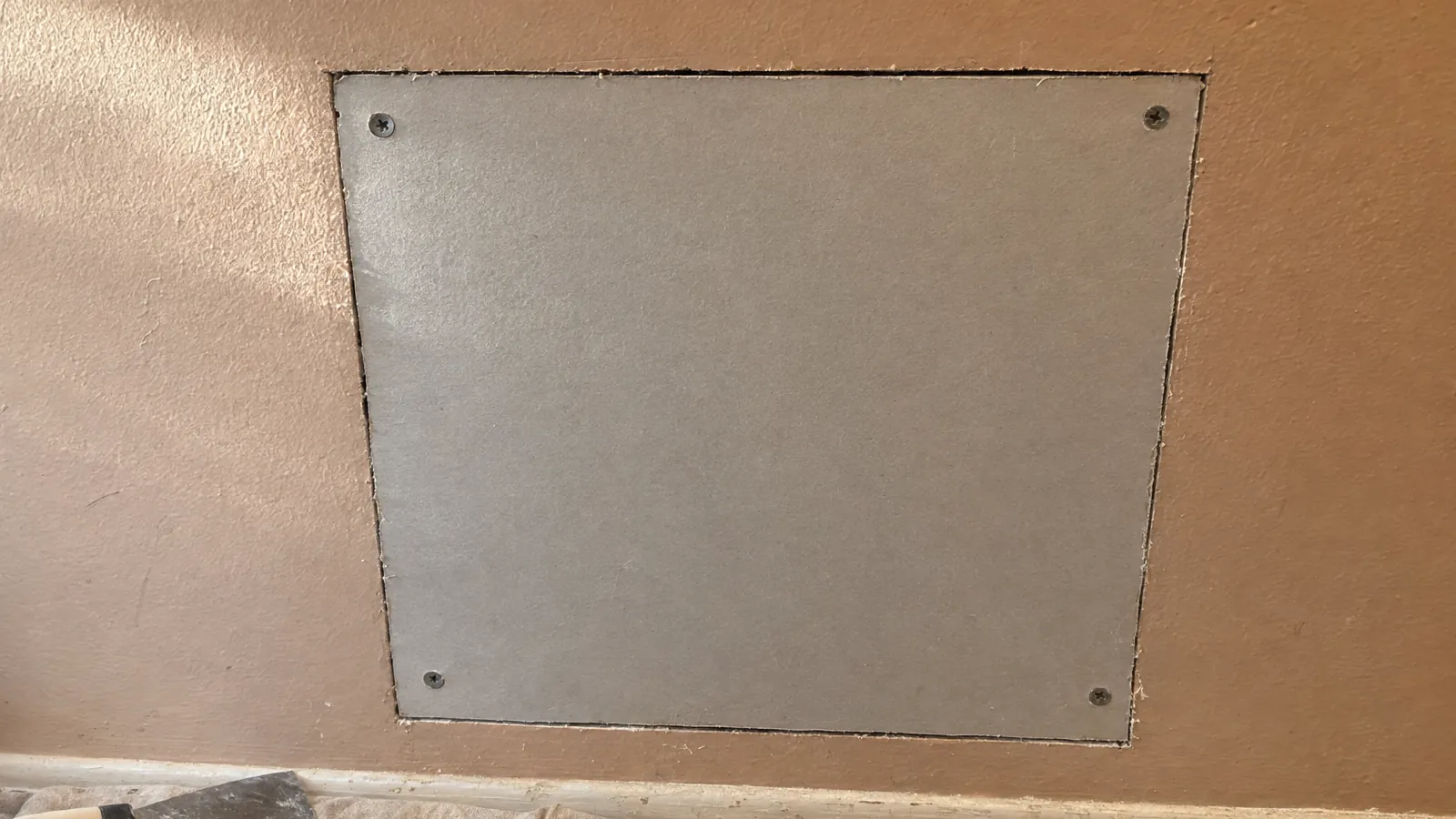
Every wall shows you where it hurts: a seam that splits along the ceiling line, a brown ring that appeared after a spring storm, a patch somebody sanded flat on a textured wall, a round hole where a doorknob landed. Some folks call it sheetrock repair and some call it drywall patching; it's the same gypsum board either way, and Perryton Drywall Repair handles all four of these jobs.
Seams that split and cracks that climb from door and window corners, opened up, retaped and feathered out wide.
Fixing seams and cracksCeiling board browned or softened by a roof leak, removed to sound framing and rebuilt, the old ring locked under shellac primer.
Ceilings after hail and leaksPopcorn, knockdown, skip trowel or orange peel rebuilt over new board until the eye slides right past the patch.
Getting the texture to matchDoorknob holes, moving-day dings and fist-sized breaks backed, screwed, taped and finished smooth.
Patching holes of any size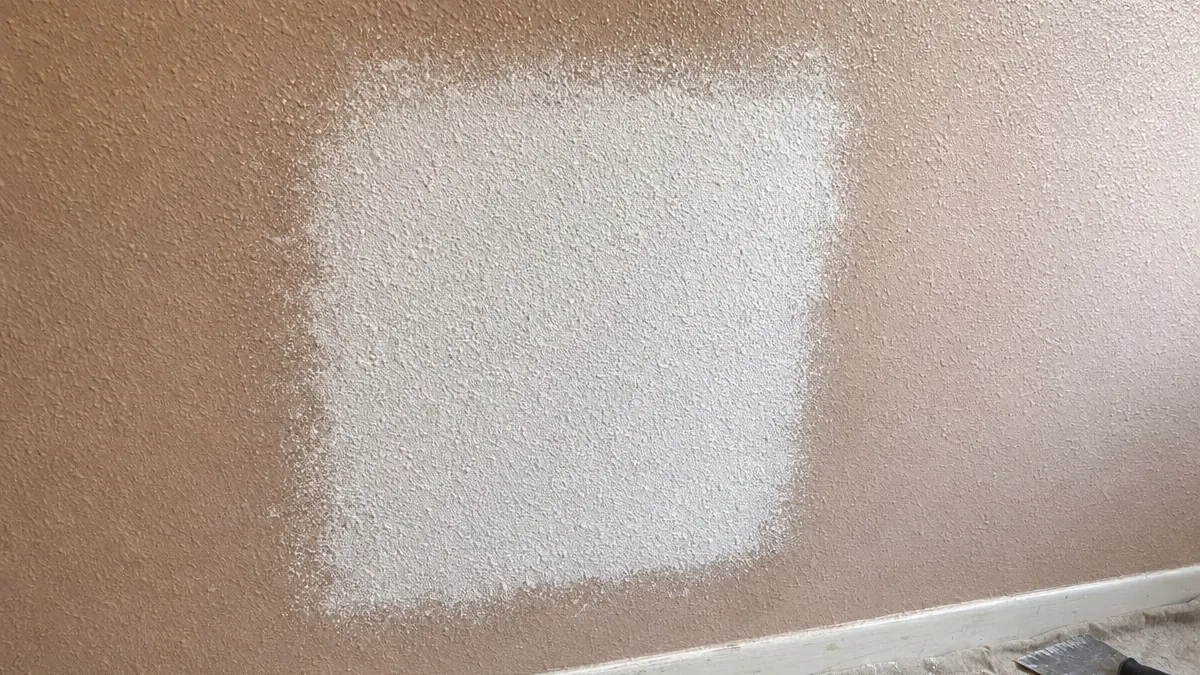
Want them side by side? The full list of drywall repairs lays out what each one involves and how they overlap, since a single storm or a single move can call for two or three of them at once.
Now and then a crack that looked like a ten-minute fix turns out to run three feet under loose tape. Drywall prices follow the wall, not the first impression.
Size comes first. A nail pop is a few minutes of work spread over several thin coats, while a two-foot hole needs new board, backing and a lot more compound. Ceilings cost more than walls of the same size because every coat goes on overhead and joints are harder to hide when low sun from a window rakes across them. Texture adds a step: smooth walls need extra sanding to look right, and knockdown or orange peel has to be rebuilt and blended. Access matters too, whether that's a tall wall over a stairway or a patch behind a built-in.
Moisture changes everything. If the board is still damp, it has to be cut out and the source fixed before any repair will hold. And then there's paint: a patch almost always needs primer, and carrying the paint to the nearest corner keeps the patch from showing as a square.
For a national yardstick, Thumbtack's drywall repair cost guide (last updated April 2026) puts typical jobs between about $294 and $920, with most people paying around $515. That figure covers markets all over the country and isn't a Perryton price. The real figure for your wall comes from the drywall pro who reads your description, studies the photos and prices that job.
Drywall damage comes in roughly three sizes, and each one changes the coat count, the drying time and how much of the wall gets repainted.
Nail pops, screw heads pushing through, dents from a chair back and hairline cracks. The loose screw or nail is reset with a new screw beside it, the spot is built up with a few skim passes of compound, sanded flat and spot-primed. Thumbtack's national guide lists a five-foot wall crack at about $125.
Doorknob strikes and holes up to about as wide as a grapefruit. Wood backing is fastened behind the opening and a fitted square of board is screwed to it, the seams are taped with mesh or paper, and three coats bring it flush. Perryton's semi-arid air, with under 23 inches of precipitation in an average year, helps drying-type compound set up sooner than it would somewhere humid.
Anything wider than a palm, or board turned mushy by water. The ruined stretch is sawn out until its edges land on studs or joists, a fresh sheet goes up, and the joints get tape, several coats, texture and primer. Plan for the work to stretch past one day; mud has to cure between passes. Thumbtack puts sanding and texturing five wall patches at roughly $200 as a national example.
Say what happened, where it is and roughly how big. A ceiling stain over the kitchen sink, a cracked seam in a back bedroom, a hole behind the laundry room door: a sentence or two is plenty to get a price started.
Rather talk it over?(806) 491-1419Call 7 days, 7am–9pm
Whatever you write here lands with a drywall pro around Perryton, who answers with questions and then a price.
Some drywall damage is a chore that can wait until spring. Some of it is a warning. Here's how to tell the two apart.
A ceiling that is sagging, soft or dripping comes first. Cut the electricity first: find the breaker marked for that room's ceiling lights or fan and flip it off, since a soggy patch overhead and live wiring don't mix. Then empty the room of children and animals and position a pail under the belly of the sag. A stain that grows a little after each storm tells you the roof still has an opening. A crack you can watch creep along month by month, or one that appeared about the time a door started sticking, points to movement worth looking into. And a hole in the shared wall where the garage meets the living space shouldn't sit open long, since that wall is part of what slows a garage fire.
Nail pops, a hairline seam crack that gapes in January and tightens up by July, a dent behind a door, and an old stain that hasn't grown since the roof was fixed. None of them is likely to get much worse in a month or two, so they can be gathered up and handled in one repair when the timing suits you. Keep a list as you find them; it makes the quote simpler.
Perryton lies a few miles below the Oklahoma border, where U.S. 83 crosses Texas 15, and repairs are arranged out along those roads as well. Booker, where Texas 15 meets Texas 23, straddles the Ochiltree–Lipscomb county line to the east-northeast. Spearman, the Hansford County seat, lies to the southwest, with Gruver farther west. Follett and Higgins are Lipscomb County towns out to the east, and Waka is the small community along Texas 15 southwest of town.
Each one gets a few lines of its own on the page of towns around Perryton.
Remember the first time you noticed that crack over the bedroom door? Here's how it gets from there to a wall you stop noticing.
It starts with a call to the number shown at the very top, or a picture of the damage texted from your phone. We take down what happened, where it is and how to reach you, and line up pricing from a drywall pro around town suited to the job.
Expect that pro to call or text, ask about texture and paint, and agree on the cost with you before the wall gets opened up. If the number works for you, the repair is booked for a day that fits your week.
The repair itself follows the damage: whatever is broken or wet is cut out, new board goes in where it's needed, then tape, coats of compound, sanding, texture to match and primer. What you end up with is a wall sealed with primer and ready for your roller, or finished in paint too when the quote included it. There's more on how Perryton Drywall Repair works, including the area served.
Drive down almost any residential street in Perryton and you pass houses from the same few decades, most of them single-story, set back on wide lots under the Panhandle sky.
About 3,747 homes stand in the city, according to five-year Census Bureau estimates spanning 2020 to 2024, and the median one was built in 1974. The 1960s are the single biggest decade: 1,026 of the houses on the ground today were framed then, and 2,074, more than half the total, belong to the three decades from 1950 to 1979. That fits the town's story. The Texas State Historical Association notes that oil and gas drilling near Perryton gave the local economy a lift in the 1950s, a few decades after the town was laid out along the new railroad in 1919.
Roughly three in four homes are detached houses, and 592, about one in six, are mobile homes. A mere 210 predate 1950. A house from the '60s or '70s usually has drywall with half a century of settling, paint and patching on it, and textures that were sprayed long before anyone planned on matching them. Mobile homes often have thinner wall panels, some with a vinyl face, so the patch material has to suit the wall. There's more on that in the guide to walls in older Perryton houses.
Tell us what the wall or ceiling looks like and where it is in the house, and the rest gets set up from there.
After that, your phone rings with a Perryton drywaller, and you two settle the cost while the wall is still untouched.